Laser Cutting Nozzle Size Chart: Complete Guide (Raytools / Precitec Compatible)
The nozzle is the last component your laser beam passes through before it reaches the sheet — and one of the cheapest parts on the whole machine. Yet a wrong bore diameter or an ill-fitting nozzle seat can ruin cut quality, waste assist gas and cost hours of downtime every week. In this guide we explain how laser cutting nozzle sizes are specified, which bore diameter matches which material and power level, and how to find the right consumable for Raytools, Precitec, WSX and other popular fiber laser cutting heads.
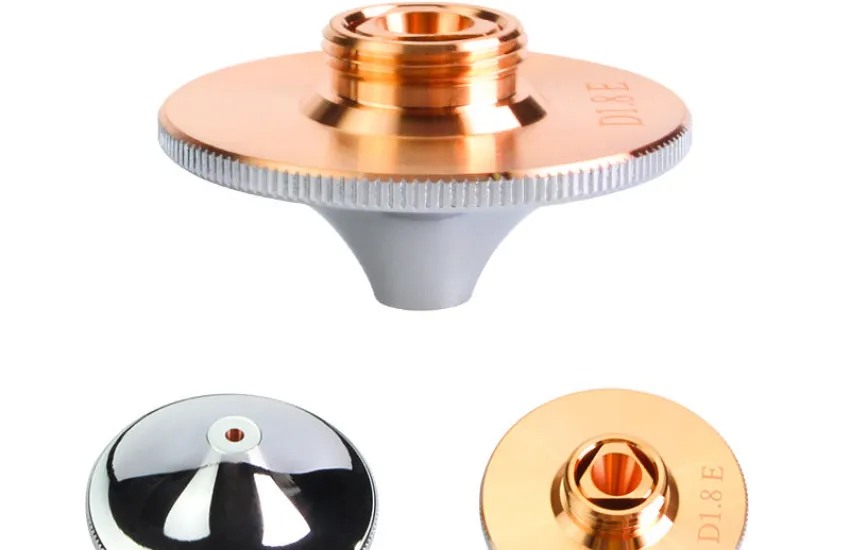
How a Laser Cutting Nozzle Is Specified
Fiber laser nozzles are usually described by three dimensions:
- Diameter (D) — the outer diameter of the nozzle body, typically 28 mm or 32 mm. This must match the nozzle seat of your cutting head.
- Height (H) — the overall length of the nozzle, commonly 15 mm.
- Thread / connection — how the nozzle screws into the holder, e.g. M11 or M14.
A typical ordering description looks like "D28 H15 M11, Ø1.5 bore, single layer". The bore diameter (the small orifice in the tip) is what you change to suit the material and thickness you cut; the outer D/H/thread must simply match your cutting head.
Nozzle Bore Size Chart (Typical Reference Values)
The table below summarises common industry practice for fiber laser cutting. Treat it as a starting point — the optimal bore also depends on your laser source, assist gas pressure and focal length, so always confirm with your machine's cutting chart.
| Bore Diameter | Assist Gas | Typical Power | Typical Application |
|---|---|---|---|
| Ø1.0 – 1.2 mm | Oxygen / Nitrogen | 1 – 3 kW | Fine cutting of thin sheet, small holes, high-precision contours |
| Ø1.5 mm | Oxygen | 1 – 4 kW | Carbon steel 1 – 6 mm (most common all-round bore) |
| Ø2.0 mm | Oxygen | 3 – 6 kW | Carbon steel 6 – 10 mm |
| Ø2.5 mm | Nitrogen | 4 – 8 kW | Stainless steel 3 – 8 mm with high-pressure N2 |
| Ø3.0 mm | Oxygen / N2 | 6 – 12 kW | Carbon steel 10 – 16 mm; stainless 8 – 12 mm |
| Ø4.0 – 5.0 mm | Nitrogen | 12 kW+ | Thick plate, high-speed large-format cutting |
Rule of thumb: smaller bores give a sharper gas stream and cleaner edges on thin material but clog easily and tolerate less misalignment; larger bores are more forgiving and deliver the gas volume needed for thick plate and nitrogen cutting.
Single Layer vs Double Layer
- Single layer nozzles are used mainly for oxygen cutting of carbon steel. The open design lets the oxidation reaction assist the cut.
- Double layer nozzles add an inner chamber that swirls and collimates the gas stream — the standard choice for nitrogen cutting of stainless steel and aluminium, where edge quality depends on a stable, oxide-free gas flow.
Compatibility with Popular Cutting Heads
Most Raytools, WSX, BOCI and Ospri fiber laser cutting heads use the Ø28 × 15 mm nozzle standard with M11 or M14 threads, which is why "D28 H15" is the most-searched nozzle spec worldwide. Precitec and some OEM heads use their own seats and thread sizes, so the nozzle is not always cross-compatible even when the bore looks identical.
| Cutting Head Brand | Common Nozzle Standard | Notes |
|---|---|---|
| Raytools (BM109 / BM111 series) | D28 × H15, M11 / M14 | Widest aftermarket availability |
| WSX (NC30 / NC60 series) | D28 × H15 | Same family as Raytools in most versions |
| BOCI / Ospri | D28 × H15 | Check thread per head model |
| Precitec | Head-specific seats | Send us your head model for a match |
Nozzle Material Matters
Quality nozzles are made from high-conductivity copper, often with a chrome-plated surface that resists oxidation and spatter adhesion. Cheap brass nozzles lose their orifice shape quickly at high power, which shows up as widening kerf and inconsistent edges long before the nozzle looks visibly damaged.
When to Replace a Nozzle
As a rule of thumb, a nozzle survives roughly 200–500 piercings before its bore degrades enough to affect cut quality (the exact number depends on power and material). Replace the nozzle when you notice: widening or inconsistent kerf, burrs on one side only, unstable capacitor signals during height tracking, or visible spatter build-up inside the bore that cleaning cannot remove.
Frequently Asked Questions
1. Can I use a larger bore to "get more speed"?
Not by itself. Bore size must match the gas dynamics of your cutting chart. An oversized bore on thin material lowers gas velocity and produces rougher edges.
2. Are all D28 nozzles interchangeable between brands?
The outer dimensions may match, but seating angle, bore concentricity and thread differ between genuine and aftermarket versions. Buy from a supplier that states head model compatibility explicitly.
3. Single or double layer for galvanized steel?
Most shops cut galvanized sheet with nitrogen and a double-layer nozzle to control dross; high-power oxygen cutting is also used. Follow your machine's cutting chart for the specific thickness.
4. How tight should I install the nozzle?
Hand-tight plus a light firming with the correct tool is enough. Over-tightening deforms the copper seat and causes eccentricity, which shows up as a slanted cut face.
Need a Size Chart for Your Machine?
Yangzhou Ruiying International Trade Co., Ltd. supplies single- and double-layer laser cutting nozzles (D28 H15 and other standards) compatible with Raytools, WSX, BOCI, Ospri, Precitec and other mainstream heads, with wholesale pricing for distributors and service centers. Send us your cutting head model and material range, and our team will recommend the right bore sizes — free samples can be arranged before bulk orders.
- Browse our full range: Laser Nozzles
- Related parts: Laser Protective Lens | Laser Cutting Parts
- Inquiries: Contact us — marketing@ttsurl.com