
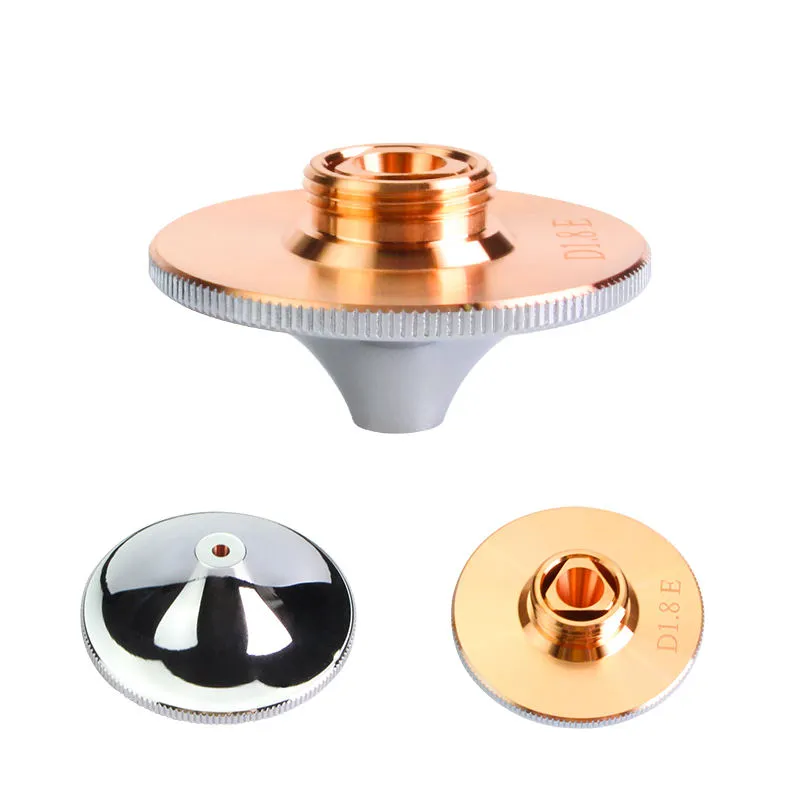

Laser Nozzles
Single and double-layer copper nozzles from 0.8 mm to 6.0 mm bore, for fiber and CO2 cutting heads. Threads matched to Raytools, Precitec, WSX, Bodor and HSG, in standard and high-pressure profiles.
The nozzle does two jobs, and only one of them is about gas
Everybody knows the nozzle delivers assist gas to the cut. The second job is less obvious: it sets the mechanical standoff between the beam and the plate, and it is the part that gets hit when the head dives into a tip-up or a warped sheet. A nozzle that is worn, oval, or half-blocked changes both jobs at once, which is why nozzle faults so often get misdiagnosed as focus or gas problems.
Single layer or double layer
Single-layer nozzles have one gas passage and give a soft, wide cone. They suit thin sheet, low-pressure cutting, and jobs where you want a gentle gas envelope rather than a hard jet. They are also the cheaper option for shops that go through a lot of nozzles on thin material.
Double-layer nozzles have an inner core jet and an outer shielding flow. The core does the cutting and the outer layer keeps the cut zone clean, which is what makes high-pressure cutting of thicker plate and stainless practical: better dross control, less oxidation on the cut face, and a more stable process at the upper end of the thickness range. The trade-off is cost and a smaller tolerance for centring errors.
The two numbers that identify the part
Almost every nozzle enquiry comes down to bore and thread. Bore is the orifice diameter at the tip; thread is what holds the nozzle on the head. Get those two right and the rest is layer type and profile.
Our nozzles are chrome-plated copper, and the D28 H15 body size — 28 mm across the body, 15 mm tall — is the one we hold for Raytools, WSX and BOCI heads. That body size is why a nozzle from one of these heads will not fit the others even when the bore is identical.
| What to specify | Range we supply | What it changes on the machine |
|---|---|---|
| Bore (orifice) diameter | 0.8 mm to 6.0 mm | Gas flow and velocity at the kerf. Small bore concentrates the jet for thin sheet; large bore feeds thick plate and reduces dross. |
| Layer type | Single layer, double layer | Soft wide cone for low pressure versus core-plus-shield for high pressure and thick material. |
| Profile | Standard, high pressure | Internal geometry tuned for the pressure range you actually run. |
| Thread | Matched to Raytools, Precitec, WSX, Bodor and HSG heads | Whether it fits at all, and how well it centres. |
Bore selection is usually a test, not a calculation. Two shops running the same material on the same machine can end up on different bores because their gas supply, their chiller and their tolerance for dross all differ. Start from the bore the machine builder specified, then move one step at a time and keep the good sample.
Reading a bad nozzle from the cut edge
| Cut or machine symptom | What it points to | What to check |
|---|---|---|
| Heavy, rough dross on the underside | Jet losing energy before it reaches the bottom of the kerf | Bore worn oversize, or pressure too low for the thickness |
| Dross on one side only | Bore damaged on one flank, or nozzle not centred on the beam | Centring jig and a visual check of the orifice under magnification |
| Incomplete cut at corners and at the end of a contour | Bore partially blocked, or too small for the corner speed | Compare with a fresh nozzle of the same bore |
| Spark shower upward and a hazing protective lens | Bore worn, standoff too high, piercing too close to the edge | Nozzle bore, standoff height, pierce position |
| Cut is fine but gas consumption climbs | Bore larger than the job needs | Step down one bore size and compare edge quality |
Consumable discipline pays better than nozzle hunting
Nozzles are the cheapest part in the cutting head and the one most often run past its useful life. A simple rule works: keep a labelled sample of the bore you are happy with, replace on a schedule rather than on a symptom, and log the change with the cut parameter that changed. Two minutes of logging per shift is what turns "the machine is cutting badly again" into a nozzle change instead of a service call.
Ordering
Send bore, layer type, thread or head model, and quantity. If you are not certain of the thread, tell us the head model and we will match it. We supply in wholesale quantities and under OEM packaging for distributors, and we can group an order with protective windows and ceramic rings so that one shipment covers a full overhaul.