Laser Focus Lens: Focal Length, Thickness, and When the Lens Is the Problem
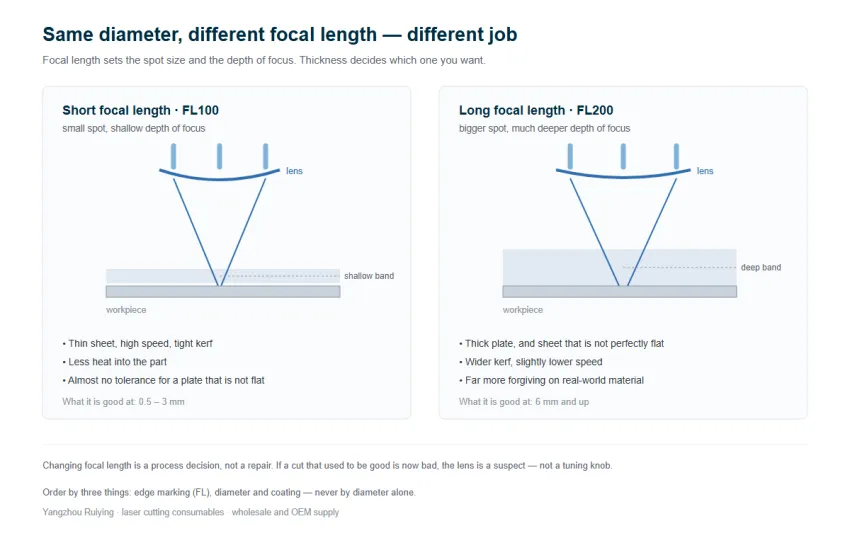
The short answer. Focal length is chosen by thickness, not by power and not by what is in stock. Short focal lengths (FL100–FL125) give a small spot and a shallow depth of focus — clean edges on thin sheet, almost no tolerance for a plate that is not flat. Long focal lengths (FL155–FL200) give a bigger spot and a much deeper usable focus — slower on thin sheet, far more forgiving on thick plate. And if a cut that used to be good is now bad, the lens is a suspect, not a knob to adjust.
What focal length actually changes
Two things, and they move in opposite directions.
| Short focal length | Long focal length | |
|---|---|---|
| Spot size at the plate | Smaller — higher energy density | Bigger — energy spread over a wider spot |
| Depth of focus | Shallow — the window where the cut works is narrow | Deep — the process tolerates the plate moving up and down |
| Kerf | Narrow | Wider |
| Speed on thin sheet | Fast | Slower |
| Tolerance to real-world material | Low — a warped sheet shows up immediately | High |
| Where it is used | 0.5–3 mm sheet, fine contours, tight kerf | 6 mm and up, thick plate, uneven material |
The practical rule: focal length follows thickness. A shop that runs 1 mm stainless all day wants a short focal length because the spot is the whole game. A shop cutting 12 mm mild steel wants a long one, because a shallow focus on thick plate means the bottom of the kerf never sees the same conditions as the top.
What is not true is that a longer focal length is an upgrade. It is a different process window. Fitting FL200 to a machine that was set up for FL125 makes it worse at the job it was doing, and the operator will spend a week trying to fix it with gas pressure.
How a focus lens is actually specified
Three numbers and one marking. Get them in this order:
- Focal length (FL) — engraved on the edge of the lens, and printed on the module. This is the only reliable identifier once the lens is out of its packaging.
- Diameter — set by the cartridge or holder, not by preference. A D30 lens will not drop into a holder machined for D28, whatever the focal length says.
- Coating — 1064 nm AR for fiber. A lens with a CO2 coating in a fiber head absorbs instead of transmitting, and the failure shows up as a power drop before it shows up as a burn.
- Orientation — a lens has a coated face and a direction. Fitting it reversed is one of the most common causes of an immediate, unexplained loss of power after a service.
Focal length and diameter are independent. The same head family can run different focal lengths in the same diameter, which is exactly why an order that says only “D30 lens” is an incomplete order.
What the head families actually take
Specifications below are from the head makers' published data; they are here so you can match a part, not as a claim that we stock every variant.
| Head | Collimating | Focusing | Cover glass, upper / lower |
|---|---|---|---|
| Raytools BM111 (3.3 kW) | F75 / F100 | F125 / F155 / F200 | 24.9 × 1.5 / 27.9 × 4.1 |
| Raytools BM114 / BM114S (6 kW) | 100 | 150 / 200 | 37 × 1.6 / 37 × 7 |
| Raytools BM115 (6–12 kW) | 100 | 150 / 200 | 37 × 1.6 / 37 × 7 |
| Raytools BM06K (6 kW) | 100 | Per module marking | D21.4 family — measure the old part |
| Precitec LightCutter / ProCutter | Per head | 100 / 125 / 150 / 200 | 30 × 5 / 37 × 7 |
| WSX KC13 / NC60 | 75 / 100 | 125 / 150 | 30 × 5 / 37 × 7 |
Two patterns are worth noticing. Collimator and focus lens are a matched pair: the collimator sets the beam diameter that reaches the focus lens, so changing one without the other moves the focal point in ways the parameter table does not expect. And the cover glass sizes move with the head generation, not with the lens — a 6 kW head with a 37 mm window can still take a D30 lens.
Why lenses die, and what it says about the rest of the stack
A focus lens is not a wear part in the way a nozzle is. It fails for four reasons, and three of them are upstream of the lens:
| Failure | What it looks like | What caused it |
|---|---|---|
| Burn spot at the centre | A dark dot or pit in the beam area | Spatter reached it — which means the protective window was already compromised |
| Halo or rainbow ring | Colour fringing under oblique light | Coating degradation; the lens is scattering instead of transmitting |
| Crack from the rim inward | A clean line starting at the edge | Mechanical: over-tightened retaining ring, or a burr on the seat |
| Gradual power loss, no visible damage | Parameters unchanged, cut quality drifting | Absorption from contamination film, or the wrong coating |
The first row is the one that costs money twice. If a lens burned, the window in front of it failed first, and replacing only the lens means the new one dies the same way. Change both, and check the gas purity while the head is open — a film on the optics usually has a cause in the assist gas.
When to change the lens, and when to look elsewhere
Before spending on optics, separate the three things that present as “the cut got worse”:
- Focus position drifted (a parameter change, not a part) — the head still focuses, just at the wrong height. Check the autofocus module and the calibration, not the lens.
- Window failed — usually the cheapest explanation and the most common. Look at the window first; a hazed window absorbs energy and makes a perfectly good lens look bad.
- Lens failed — the symptoms in the table above, plus a visible mark or a focal length that no longer matches the cut behaviour on a test sheet.
If a lens is replaced, run a test cut at the thickness that normally gives trouble, and keep the old part marked with the date. A lens that dies in weeks rather than months is telling you something about the window, the gas, or the cooling — not about the lens supplier.
Supply
We supply fused silica focusing and collimating lenses for fiber heads, D30 with FL100 and FL125 as stock sizes and the rest of the 63.5–254 mm range to order, edge-marked with focal length and coating. ZnSe optics for CO2 systems are a separate line and never interchangeable. Wholesale quantities and OEM packaging; see the focus and collimator lens range.
Send the head model and the edge marking from the old lens, or a photo of it next to a rule. That answers the three questions that matter — diameter, focal length, coating — in one reply, and avoids the most expensive mistake in this category: a correct-looking lens at the wrong focal length.
FAQ
Can I fit a longer focal length to cut thicker plate?
Only as a process change, and only if the collimator and the parameter table move with it. A longer focus lens on a machine set up for a short one widens the kerf and slows the cut before it improves anything. Thick plate is normally handled by the head's designated focal length plus the right nozzle and gas, not by swapping in a longer lens.
Is the focusing lens the same as the collimating lens?
No. They often look similar and are bought as a pair, but the collimator makes the beam parallel and the focus lens converges it. They have different focal lengths, different positions in the head, and they fail differently — a wrong collimator shows up as a kerf that will not close, a wrong focus lens as a spot in the wrong place.
How do I know which focal length is in my head?
Read the edge marking on the lens. If the lens is out and unmarked, the module marking or the machine's parameter set is the next best source. Do not infer it from the thickness you cut — the same thickness can be run with two different focal lengths by design.