
Single Layer vs Double Layer Laser Nozzles: What the Gas Decides
The short answer. The layer type follows the assist gas, not the power. Double layer is the standard for oxygen cutting of carbon steel — the inner core shapes the oxygen jet, the outer chamber shields it. Single layer is the standard for high-pressure nitrogen on stainless and aluminium, where the job is to deliver gas volume with nothing in the way. If a supplier tells you it is the other way round, ask them to explain what the second layer is for.
What the second layer is actually doing
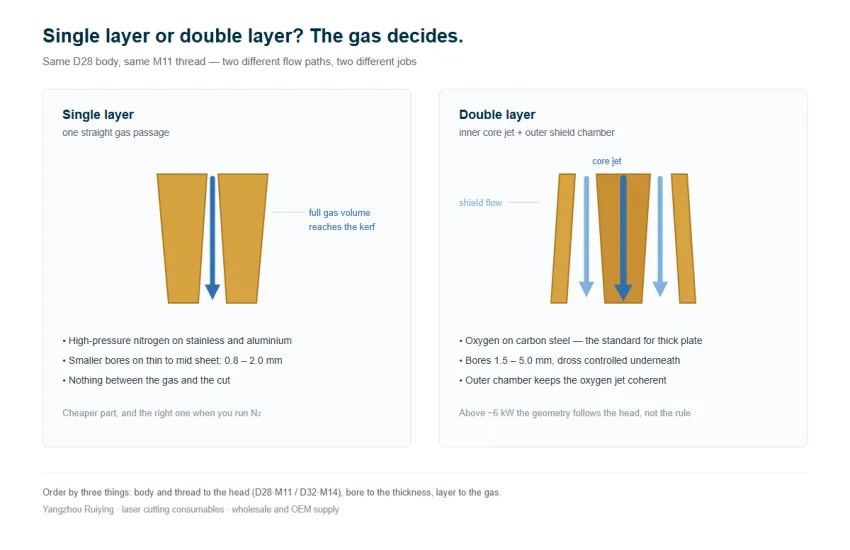
A single-layer nozzle has one gas passage. Everything the gas does happens in that one channel, so the exit is a cone of gas whose shape is set by the bore and the standoff.
A double-layer nozzle adds a second, annular passage around the core. Two flows leave the same tip: a core jet through the middle and a shield flow around it. On oxygen cutting that shield is what keeps the oxidation reaction where you want it — it stabilises the jet, limits how far the oxygen spreads across the cut face, and is a large part of why dross stays on the underside instead of welding itself to the edge.
That is a gas-dynamics job, not a power rating. Which is the first sign that the layer type is being chosen for the wrong reason on a lot of shop floors.
Which layer for which gas
| Cutting | Layer type normally fitted | What it is for |
|---|---|---|
| Carbon steel, oxygen | Double layer | Core jet plus shield: keeps the exothermic reaction tight, controls dross on thick plate |
| Stainless steel, high-pressure nitrogen | Single layer | One unobstructed passage: maximum gas volume and velocity at the kerf |
| Aluminium, nitrogen | Single layer | Same reason as stainless; edge quality depends on gas volume, not on shielding |
| Thin sheet, air or nitrogen | Single layer | Small bore concentrates the jet; the second layer would add nothing at this thickness |
| Thick plate above roughly 6 kW | Depends on the head | High-power heads change nozzle geometry, and the OEM process list wins over any rule of thumb |
If you only remember one line from this page: double for O2, single for N2. It covers most of what a job shop actually runs.
Telling them apart when they are in your hand
From the outside they look alike, which is how the wrong one ends up in the drawer. Three things separate them:
- Look into the exit. A double-layer nozzle has a visible inner core: a smaller ring or cone inside the mouth. A single-layer nozzle is one open cone with nothing inside it.
- Look at the label and the price. Double layer costs more to make, and a listing that prices them identically is usually selling one part under two names.
- Look at what came off the machine. This is the only reliable method. If the old nozzle had an inner core, the head was set up for a double layer, and the process parameters were written for it.
The bore diameter, the height and the thread are identical between the two types — that is exactly why they get mixed up. D28 × H15 with M11 thread exists in both, and so does D32 × H15 with M14. The layer is a separate decision sitting on top of the same three numbers.
Where the rule stops holding
Three situations where "double for O2, single for N2" is not the whole answer:
- Above roughly 6 kW. High-power heads use their own nozzle geometries and their own process windows. Some run a single-layer nozzle on carbon steel because the speed matters more than the dross margin. Copy what the head maker specified before you copy a rule from a blog.
- Very thick stainless on high-pressure nitrogen. Some shops move to a double-layer nozzle here, not for the oxygen reaction but to keep a stable gas envelope at very high flow. If your edge quality falls away at the top of the thickness range, this is worth a trial.
- Mixed-material shops. If one machine cuts carbon steel in the morning and stainless after lunch, the nozzle change is part of the setup, not a consumable restock. Two labelled drawers beat one drawer with a guess in it.
Buying both is cheaper than guessing
A nozzle is the cheapest part in the beam path and the one whose geometry most directly decides the cut. If you are unsure which type your head was set up for, order one of each in the bore you already run, cut the same job twice, and compare the underside. That test costs less than an hour of chasing dross with gas pressure and focus.
We supply both types in the D28 × H15 M11 and D32 × H15 M14 bodies, chrome-plated copper, in bores from 0.8 to 6.0 mm — see the nozzle range. If you are still working out which bore you need, the bore table starts from thickness and gas rather than from the part number.
FAQ
Can I run a single-layer nozzle on carbon steel?
Yes, and plenty of shops do, especially on thin sheet where the cut is fast and the oxygen has less time to spread. What you lose is the dross margin on thicker plate. If the underside starts needing attention at 6 mm and above, that is the sign to go back to double layer.
Why does my supplier list single layer for stainless if double is better?
Because on stainless the constraint is gas volume, not shielding. High-pressure nitrogen needs a large, unrestricted passage; an inner core is an obstruction in that path. "Better" depends on which job the nozzle is being asked to do.
Is the bore the same between the two types?
Yes. The bore, the body diameter, the height and the thread are shared; the layer is a separate feature. That is why an order that says only "D28 H15 M11, 1.5 mm" is incomplete — it does not say which one you want.