Laser Sensor Cable Faults: When a Cable Rings Out Fine but the Head Hunts
The short answer. The cable in the height-control loop carries a measurement, not power. A meter that beeps on the cores tells you almost nothing, because the failure that causes height faults is usually in the shield, the drain or the pinout — all of which pass a continuity test while the head hunts.
What that cable is actually carrying
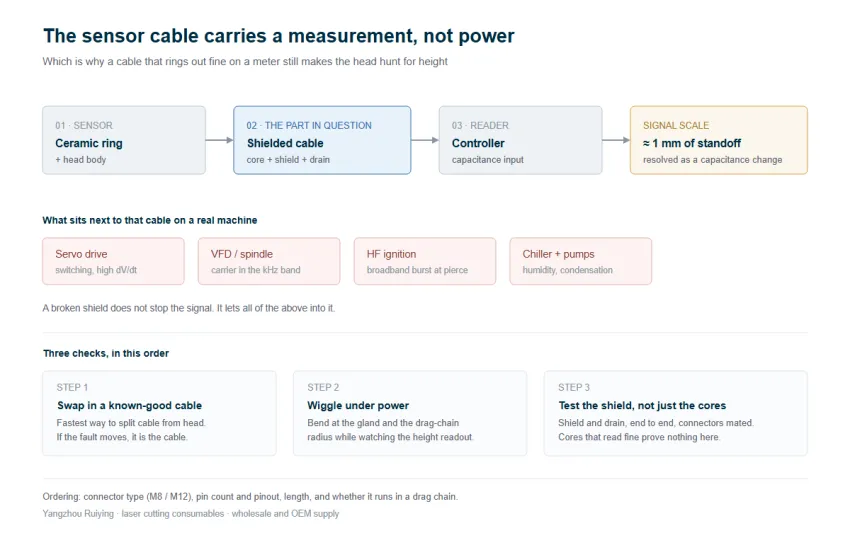
A capacitive height control measures the capacitance between the ceramic ring at the tip of the head and the workpiece, and turns a change of a fraction of a picofarad into a standoff correction. The whole loop runs from the ring, through the head body, up the cable, into the controller.
That signal is tiny, and it lives on a machine with a servo drive switching at kilohertz, a VFD for the chiller or the extraction, an HF ignition at every pierce, and a plasma-adjacent environment on some floors. The cable is not a wire — it is the only thing keeping that measurement separated from all of it.
Four faults that pass a meter test
| What fails | Why a continuity test misses it | What the operator sees |
|---|---|---|
| Shield broken at the gland or cable tie | The cores still read through; only the shield is open | Height drifts, or jumps when the machine moves in a particular direction |
| Drain wire left floating at one end | Nothing is disconnected — the drain was never terminated | Noise that appears only when the servo or HF is active |
| Pinout swapped between cable and controller | Every pin has continuity; two of them are in the wrong place | Reads a fixed offset, or faults on calibration rather than during a cut |
| Strain at the drag chain or a tight bend radius | The conductor is intact at rest and open in motion | Intermittent faults that vanish when the machine is stopped |
The pattern to notice is when the fault appears. A fault that only exists while the machine is moving, or only while the HF is firing, is almost never a sensor problem — it is a shielding or termination problem, and the cable is the first suspect.
Three checks, in this order
- Swap in a known-good cable. Not a repair, a swap — the point is to move the fault, not to fix it. If the height fault follows the cable, you are done diagnosing. If it stays with the head, the cable is exonerated and you look at the ring, the contact pin and the controller input.
- Wiggle under power. Bend the cable at the gland, at the cable tie and at the drag-chain entry while watching the height readout on the controller. This catches the strain fault that a static test cannot see. Do it with the laser off and the machine in a safe position — you are watching numbers, not cutting.
- Test the shield end to end, not the cores. With the connectors mated, check shield-to-shield and drain-to-drain resistance through the whole run. An open shield with intact cores is the single most common hidden fault in this loop, and it is invisible to the test most people run.
What to specify when you order one
Cables are not interchangeable across heads, and the failure mode of a wrong one is subtle rather than dramatic. Four things settle it:
- Connector type and pin count — M8 or M12 is the common split; the pin count follows the controller.
- Pinout — the assignment of signal, shield and supply on each pin. If you have the old cable, a photo of both connector faces is worth more than a description.
- Length and routing — fixed installation or drag chain. A cable that is right electrically and wrong mechanically will fail at the gland within weeks.
- Head model — because the head end of the cable is matched to the connector on the head body, not to the controller.
We supply shielded signal cables for capacitive height controllers and cutting-head interfaces in M8 and M12, with the pinout matched to your controller — see the sensor cable range. If you are not sure which one is fitted, send photos of both connector faces and the head model; that answers it in one reply.
FAQ
Can a bad cable really cause a crash?
Yes, and it is the expensive version of this fault. If the controller loses the measurement it either faults out or keeps following a noisy signal, and following noise at 6 mm standoff is how a head meets a tip-up. Intermittent height faults are worth chasing before they become a nozzle-and-ceramic event.
The cable looks fine. Can it still be the problem?
That is the normal case. Shield damage and a floating drain are invisible from the outside, and a cable that has been flexing in a drag chain for a year looks exactly like a new one until you test the shield.
Do I need the same brand of cable as the controller?
No — you need the same electrical arrangement: pinout, shielding and connector. The brand on the cable is not the specification. What matters is that the shield is terminated at both ends in the way the controller expects, and that the pinout matches.