
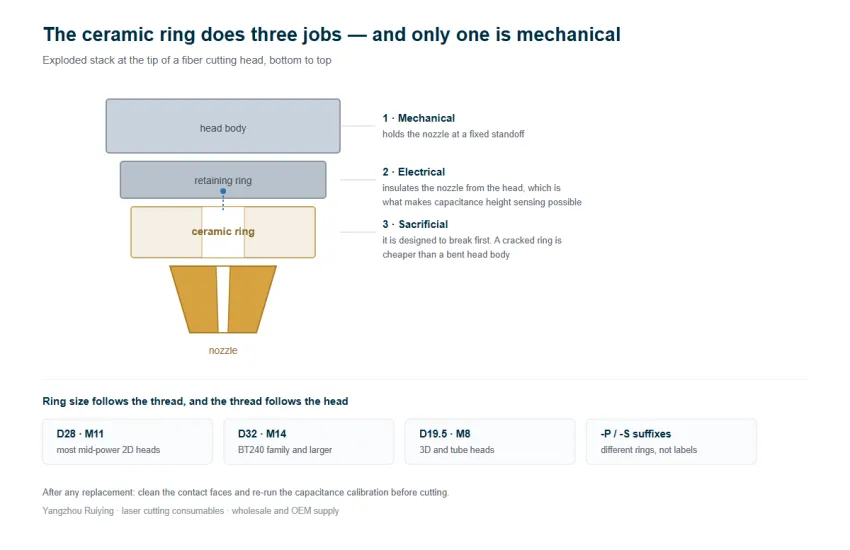
Laser Cutting Ceramic Ring: Three Jobs, and Why It Breaks First
The short answer. The ceramic ring is not just a spacer. It insulates the nozzle from the head body — which is what makes capacitive height sensing possible at all — sets the standoff, and is designed to be the part that breaks first in a crash. If it is cracked, chipped or sitting on a dirty contact face, the machine will not hold height, no matter how good the nozzle and the lens are.
Three jobs, one part
Most consumables do one thing. The ceramic ring does three, and they fail differently, which is why the same part shows up as a mechanical problem one week and an electrical one the next.
| Job | What it does | What you see when it fails |
|---|---|---|
| Mechanical | Holds the nozzle at a fixed, repeatable standoff below the head | Cut quality drifts, the nozzle sits unevenly, the head reads a different height than it did yesterday |
| Electrical | Insulates the nozzle from the head body so the tip and the plate form the two plates of a capacitor | Height faults, calibration that will not complete, or a controller reading a fixed offset |
| Sacrificial | Absorbs the impact of a crash and breaks before the head body bends | A visible crack or chip, usually after a tip-up or a warped sheet |
The electrical job is the one people miss. A ring that is mechanically intact but conductive — because of metal spatter bridging the ceramic, or a dirty contact face — gives the controller a permanently shorted capacitor. The machine does not report a broken ring; it reports a height problem, and the operator goes looking at the sensor cable.
Why they crack
In order of how often we see it:
- A crash. A tip-up, a warped sheet or a wrong pierce height. This is the design case: the ring breaks so the head does not. Replace it, check the nozzle and the protective window at the same time, because the impact usually reached both.
- The retaining ring tightened with a tool. Ceramic is strong in compression and weak in point loading. Hand-tight only — a wrench puts a stress concentration exactly where the crack starts.
- The wrong ring for the head. A D28 ring on a head that takes D32 will seat, look plausible, and sit at the wrong height. The cut then behaves as if the focus were wrong.
- Contamination on the contact faces. Not a crack, but the same symptom. Spatter and oxide on the seating face break the electrical path just as effectively as a fracture.
Sizing: the thread decides, not the model number
Ceramic rings are ordered by body diameter and thread, and the same head family can use more than one. That is why a model number alone is not enough:
| Ring | Where it appears | Note |
|---|---|---|
| D28 · M11 | Most mid-power 2D heads: Raytools BT220 / BM114 / BM115 / BS06K, and the bulk of WSX and BOCI 4-series heads | The volume size; if you only stock one ring, stock this one |
| D31 · M11 | Certain BOCI series heads | Close enough to D28 to be confused on a bench, not on the machine |
| D32 · M14 | Raytools BT240 / BT240S / BM109 / BM110 / BM111 / BM114S | The larger 2D family; M14 thread, not M11 |
| D19.5 · M8 | 3D and tube heads | Different animal: smaller body, different nozzle seat |
| D40.8 · M11 | BOCI large-format heads | Large diameter, same thread as D28 — the diameter is the tell |
| -P and -S suffixes | Specific BOCI series | These are distinct rings, not a labelling variant of the base size |
Two things this table deliberately does not do. It does not give one ring per model, because several heads have revisions that change the ring. And it does not settle the Raytools BM06K, where published lists disagree between a D21.4 ring and the D28 family — on that head, read the nameplate and measure the old ring rather than trusting any chart, including this one.
Symptoms that point at the ring
| Symptom | Why the ring is a candidate | Check |
|---|---|---|
| Height faults after a crash, even with a new nozzle | Cracked ring or a contact face that took the impact | Inspect the ring under a lamp; check both seating faces |
| Capacitance calibration will not complete | Shorted or open sensing path | Ring, contact pin, then the cable |
| Head reads a constant offset | Ring sitting at the wrong height, or the wrong ring fitted | Compare ring diameter and thread against the old part |
| Cut is fine on one side of the table and poor on the other | Ring not seated evenly, so the nozzle is not square to the plate | Seating face and retaining ring torque |
| Random stops with a “nozzle touch” alarm | Intermittent contact through a hairline crack that opens with heat | Ring, then the sensor cable — both fail this way |
Replacing one properly: the two steps people skip
- Clean both contact faces before fitting. The ceramic sits against the head body and the contact pin touches it. Spatter, oxide or a smear of grease on either face changes the reading. Wipe, blow, and check with a lamp.
- Re-run the capacitance calibration. A new ring is a new dielectric geometry; the controller's zero point moves. Skipping this is the most common reason a correctly fitted ring still cuts badly on the first sheet.
Then hand-tighten the retaining ring, fit the nozzle by hand as well, and make one test cut at the thickness that normally shows problems. If the height still wanders after a new ring, a clean seat and a calibration, the ring was not the fault — go to the sensor cable next.
Supply
We hold D28-M11, D31-M11, D32-M14 and D19.5-M8 rings as standard lines, plus the BOCI D40.8-M11 for large-format heads, in wholesale quantities and under OEM packaging. Rings are one of the parts where a mixed carton makes sense: the same head family usually needs rings, nozzles and windows together, and one shipment with one confirmation step beats three.
Send the head model and a photo of the old ring next to a rule, and we will confirm diameter, thread and suffix before anything ships — see the cutting parts range. If you are already ordering nozzles for the same head, the nozzle page covers the bore and layer side of the same decision.
FAQ
Can I run the machine with a cracked ceramic ring?
No. A crack changes both the height the nozzle sits at and the electrical path that measures it, and it can let the nozzle contact the head body directly. The failure mode is a height fault at best and a head crash at worst — the ring is the cheap part in that sentence.
Why does a new ring still give height faults?
Three usual reasons: the contact faces were not cleaned, the capacitance calibration was not re-run, or the ring is the wrong size for the head and sits at the wrong height. Work through them in that order before suspecting the cable.
Are ceramic rings interchangeable between Raytools and BOCI heads?
Only when the diameter and thread both match. D28-M11 rings do cross between several Raytools, WSX and BOCI mid-power heads because they share that interface, but the suffix variants and the larger D32-M14 family do not. Match on the numbers, not on the brand name.