
OEM vs Aftermarket Laser Consumables: Where the Cost Is
Why Per-Piece Price Misleads
Three reasons, and none of them are about quality marketing.
- Consumption frequency is not fixed. A part that fits badly gets replaced more often. If an aftermarket window hazes twice as fast, a 55% price saving becomes a 10% one.
- Downtime is not on the invoice. A failed lens stops a machine. The part is cheap; the shift is not.
- Scrap is invisible. A nozzle with a slightly off bore cuts acceptably for a week, then produces dross on a job that matters. Nobody books that against the nozzle.
So the honest comparison is annual cost of ownership, not unit price.
The Four Variables
| Variable | OEM position | Aftermarket position |
|---|---|---|
| Unit price | Higher, sometimes 2–4x | Lower, and more stable across a year |
| Replacement frequency | Baseline — the part is designed with the head | Equal if the part is correct; worse if it is not |
| Fit risk | Near zero, but revisions still happen | Depends entirely on whether the variant was verified |
| Documentation and warranty | Full, and tied to machine warranty | Varies; must be asked for explicitly |
Everything else is noise. A supplier who argues quality without addressing these four is selling, not explaining.
A Worked Example
Numbers below are illustrative — replace them with your own prices and your own consumption. The structure is the point, not the figures.
Machine: 6 kW fiber, two shifts, about 6 cutting hours a day.
| Item | Annual qty | OEM unit | OEM / yr | Aftermarket unit | AM / yr |
|---|---|---|---|---|---|
| Protective windows | 156 | $9 | $1,404 | $4 | $624 |
| Nozzles | 104 | $18 | $1,872 | $7 | $728 |
| Ceramic rings | 2 | $45 | $90 | $16 | $32 |
| Focusing lens | 0.67 | $210 | $140 | $95 | $64 |
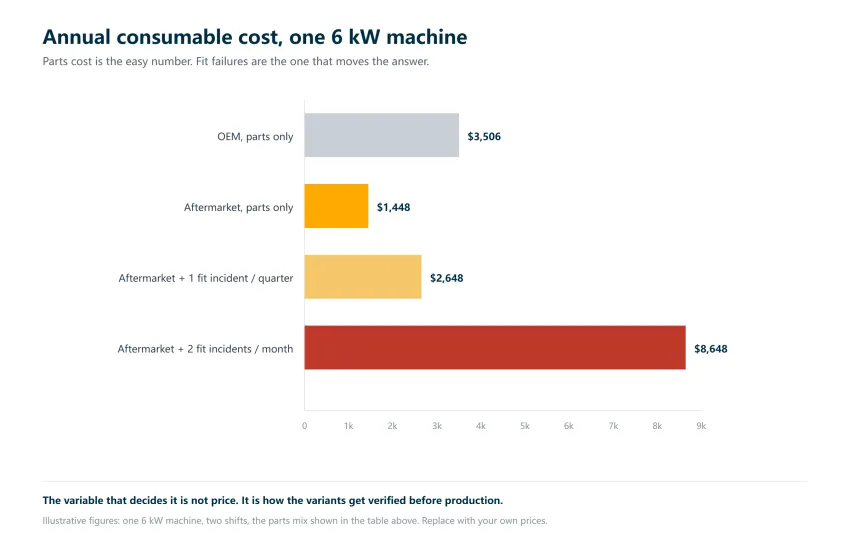
| Parts total | $3,506 | $1,448 |
Parts saving: about $2,058 a year on a single machine.
Now the counterweight. Suppose aftermarket fit problems cause one incident a quarter: two hours of downtime at $120/h plus $60 of scrapped material — $1,200 a year. The saving shrinks to roughly $860 but does not disappear.
Reverse the assumption and the answer flips: if an unverified part causes two incidents a month, the aftermarket route costs more than OEM. The variable that decides it is not price. It is how the variants get verified.
When OEM Is the Right Call
We supply aftermarket parts, and there are still cases where we tell customers to stay with the original.
- Machine under warranty. Some manufacturers tie warranty coverage to original consumables. Check the terms before switching; the saving is not worth an argument over a $30,000 head.
- Very high power, or a head revision released recently. The aftermarket ecosystem lags new revisions by months, not weeks. On a head that shipped this year, the correct part may simply not exist outside the OEM channel yet.
- Traceability requirements. Aerospace, medical and some automotive supply chains need documented provenance. If your customer audits your consumables, OEM paperwork is the shorter path.
- A process that is already marginal. If you are cutting at the edge of the parameter window, remove variables rather than add them.
When Aftermarket Wins
- Mature machines. A head family that has been in the field for years has a settled aftermarket, and the parts are dimensionally identical.
- Consumable-heavy shops. The more parts you burn, the more the annual saving compounds — and the more sense it makes to hold stock.
- Multi-brand fleets. One supplier for Raytools, Precitec, BOCI and WSX parts, in one carton, on one document.
- Service companies. You are buying for other people’s machines and pricing the job; parts cost is your margin.
How to De-Risk Aftermarket Parts
The whole risk sits in one step: confirming the variant. Ours looks like this.
- Head model and revision, not just the brand. A BM111 and a BM114 take different rings.
- Photo of the old part next to a rule, when the model number is not legible. Bore and body diameter are measurable in a photo.
- Written confirmation before production, with the variant spelled out — not “as discussed”.
- A trial quantity on the first order for the highest-consumption item, before committing to a carton.
- Labelling that keeps the batch identifiable, so a problem can be traced to a lot instead of a guess.
That process costs a day. Skipping it is what produces the horror stories that keep the OEM premium alive.
FAQ
Is aftermarket cheaper if it fails more often?
It depends on how much more often. If an aftermarket window lasts 80% as long at 45% of the price, it still wins. If it lasts half as long, the saving is gone. Measure your replacement interval for one quarter — that number decides it.
Will aftermarket parts void my machine warranty?
Not automatically, but the terms vary by manufacturer and by region. Read the warranty document before switching, and keep the OEM parts for anything the manufacturer might inspect.
How do I compare two aftermarket suppliers?
Ask all of them for the same three things: the variant confirmation in writing, the tolerance they inspect to, and what happens when a part does not fit. A supplier who answers all three in one message is a different animal from one who sends a price list.
Can I mix OEM and aftermarket on the same machine?
Yes, and many shops do: OEM for the expensive optics they are unsure about, aftermarket for nozzles and windows where the part is simple and the consumption is high. That is a rational split, not a compromise.
Get Your Variants Confirmed First
If you want to run the numbers on your own machine, send us your last 12 months of consumable purchases — part, variant, quantity — and we will tell you which lines are worth switching and which are not. No obligation, and we will say so when the answer is “stay with OEM”.
Start from the brand compatibility charts to find your head family, check variants on the protective lens and cutting parts pages, then request a quote with your list.